
This is a writing sample. I write content for dental clinics and medical tourism businesses; I do not provide treatment or clinical advice. This page was prepared with reference to the General Dental Council’s guidance on advertising and to ASA and CAP advice on dental advertising. It requires review by a registered dental professional before publication by a practice. Sources are listed at the end.
A chipped front tooth, an edge worn flat over the years, a small gap that has always shown up in photographs: these are the concerns that usually prompt someone to ask about composite bonding. The treatment uses tooth-coloured resin, placed directly onto the tooth, shaped by the dentist and set with a curing light.
The appeal is easy to understand. In suitable cases, bonding changes how a tooth looks while preserving most or all of the natural tissue underneath. What it is not is permanent, maintenance-free or right for every concern. Whether it suits you depends on the condition of your teeth and gums, the way your teeth meet, and the reason you want the change.
What composite bonding actually means
“Composite bonding” is an umbrella term rather than a single standardised procedure. The material is familiar enough, being the same resin used for white fillings; what differs is how much of it is placed, and why. That helps explain why quoted lifespans vary between procedures and patients.
- Edge bonding adds material mainly to a chipped, uneven or worn tooth edge.
- A composite build-up replaces a larger amount of lost tooth structure, typically where teeth have been shortened by wear.
- A direct composite veneer covers more of the visible front surface to change shape, proportion or colour.
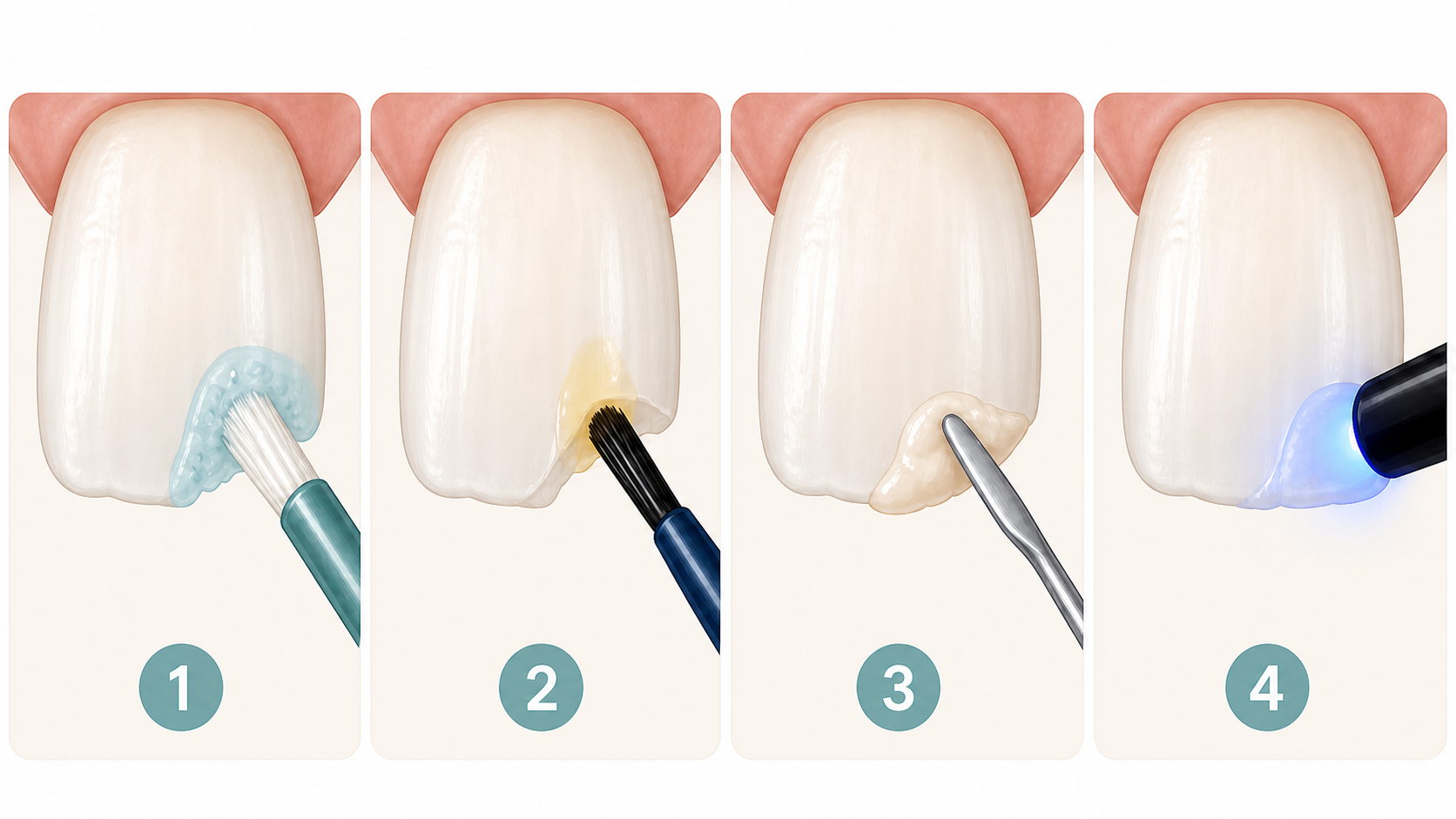
Rebuilding a small corner of one incisor is not the same undertaking as restoring several worn teeth, so planning, preparation and maintenance scale with the work involved. The underlying sequence stays the same: the surface is conditioned, adhesive and resin are applied, the material is set with a curing light, then shaped, polished and checked against the opposing teeth.
What it can and cannot address
Following an examination, composite may be used to repair a small chip, rebuild an edge shortened by localised wear, alter the shape or proportion of a tooth, reduce a modest space, improve symmetry where one tooth is smaller than its neighbour, or mask some localised colour differences under a veneer-style layer.
The limitations follow from the method. Bonding adds material; it does not move teeth. Trying to disguise marked crowding, rotation or a wide space with added resin can produce bulky, difficult-to-clean contours. Where tooth position is the underlying issue, orthodontic treatment addresses the cause rather than disguising it. Decay, inflamed gums and active or unexplained wear all need attention first, because composite placed over an unresolved problem simply inherits it.
Is composite bonding right for you?
Suitability starts with a dental assessment, not a photograph or an online quotation. The dentist needs to establish what caused the concern, and whether a bonded restoration would remain cleansable and stable under the forces your bite generates.
That examination usually takes in the health of the teeth and gums; the enamel available to bond to; existing fillings, crowns or veneers; the position of the teeth and the way they meet; signs of grinding, clenching or continuing wear; whether the area can be kept reliably dry; the origin of any discolouration; and, not least, what you expect the treatment to change.
Some situations make the result less predictable: very little sound tooth tissue remaining, a margin extending beneath the gum, or moisture that cannot be controlled. Extensive wear, severe crowding and unmanaged grinding tend to call for a broader plan rather than a cosmetic one.
Raise whitening at this stage if you are considering it, because whitening lightens natural teeth but not existing fillings, crowns or veneers. Completing it first means the composite shade can be matched to the colour you finish with, rather than the one you started from.
What happens during treatment
The stages below describe the full process. A small repair may fit into one appointment, while more extensive work may need several.
1. Examination and planning
The dentist examines the teeth, gums and bite, then discusses the realistic options. Photographs, scans, impressions or radiographs may be appropriate. For larger changes, a wax-up or temporary mock-up lets the proposed shape be reviewed before anything is bonded in place.
2. Shade selection and preparation
The shade is chosen, the tooth cleaned and the area kept dry, sometimes with a rubber dam. Some additive cases need little or no drilling, but decay, failing restorations or unsuitable contours may need attention first. Local anaesthetic is not always required, though it may be appropriate where preparation is involved.
3. Bonding and shaping
The surface is conditioned and adhesive applied. Composite is built up in layers, each hardened with a curing light, then shaped to blend with the surrounding tooth.
4. Finishing and the bite check
The dentist polishes the composite and checks how the teeth meet, since excessive contact can make a restoration uncomfortable and more vulnerable to chipping. Larger build-ups may need reviewing as the bite settles. Appointment arrangements also depend on the number of teeth involved, so “one visit” cannot be promised for every case.
What composite does well
For the right indication, composite has real practical advantages. It bonds directly to tooth tissue and can be matched to the surrounding teeth, which can allow minimal preparation in suitable cases. Because it is shaped in the mouth rather than made in a laboratory, a worn or fractured area can often be restored without covering the whole tooth. A localised defect that appears later may be suitable for polishing or repair rather than complete replacement. That does not make it permanent: a bonded restoration still needs monitoring.
Limitations, risks and maintenance
Composite changes with time and use. Studies of anterior composite restorations report fracture and chipping among the reasons for reintervention. Loss of gloss, staining, marginal discolouration, changes in shape and colour mismatch are also relevant, particularly in cosmetic cases.
Possible complications include chipping, fracture or partial loss; a stained or roughened surface; a visible line at the margin; temporary sensitivity; a contour that traps plaque; a bite that feels high; and the eventual need for polishing, repair or replacement. If your natural teeth lighten or darken over the years, the composite will not follow.
How likely any of this is depends on the size and position of the restoration, the enamel available, the conditions under which it was bonded, your bite, any grinding habit, oral hygiene and accidental trauma. Large build-ups for tooth wear are a category of their own: they can deliberately change the way the teeth meet while the bite adapts, so they need different planning and follow-up.
How long does composite bonding last?
There is no single evidence-based lifespan for composite bonding, because the term covers several different restorations, and studies of veneers, worn-tooth build-ups and anterior fillings define success in different ways. A restoration may count as surviving even after it has been polished or repaired, which is not the same as remaining unchanged.
What the research does support is that direct composite can stay serviceable for years, and that maintenance along the way is normal rather than a sign of failure. A dentist who has assessed your teeth, the volume of composite planned and the forces it must withstand can give a far more meaningful answer than any figure quoted online.
What affects the cost of composite bonding?
There is no single UK price for composite bonding. Private practices set their own fees, and a quotation depends on what is being treated rather than simply on the word “bonding”. Repairing the edge of one tooth is a different undertaking from placing several direct composite veneers or rebuilding teeth affected by wear.
The number of teeth, the amount of resin required, the complexity of the shape and bite, and whether existing decay or restorations need attention can all affect the cost. Planning photographs, scans or a mock-up may be appropriate for a larger change. Whitening beforehand, a protective appliance for grinding, review appointments and the practice’s arrangements for future repairs may also sit within or outside the quoted fee.
A practice should give you a written treatment plan before treatment starts, setting out the proposed treatment and a realistic indication of the cost. Check that it shows which teeth and appointments are included, whether any preparation is expected, and what would happen financially if the composite later needed adjustment, repair or replacement. Practices are also expected to tell patients whether treatment is guaranteed, in what circumstances and for how long.
The GDC requires practices to give clear price information in their literature and on their websites, so patients should not have to ask for it. Under the CAP Code, an advertised “from” price must not exaggerate how widely available that price actually is.
Looking after bonded teeth
Bonded teeth need the same disease prevention as natural teeth, plus protection from avoidable stress. Brush twice daily with fluoride toothpaste, clean between the teeth using the method your dental team recommends, attend reviews at the interval advised, and wear a protective appliance if one has been prescribed for grinding or clenching.
Bonded edges are not tools. Avoid using them to bite fingernails, pens, packaging, ice or other hard objects.
Ask for advice if the composite chips, feels rough, catches floss or changes how your bite feels, and resist the urge to smooth or glue a chip yourself. A dentist can often repair a local defect without replacing the whole restoration, but the bite needs checking first.
Alternatives worth considering
Leaving the tooth alone may be appropriate where the concern is minor. Otherwise, the sensible alternative depends on the reason behind it.
Smoothing or minor reshaping may be enough for a very small irregularity, and whitening is more appropriate where colour is the main concern. Orthodontic treatment moves teeth rather than making them appear straighter by adding width. Porcelain veneers have different aesthetic and longevity characteristics, and commonly involve laboratory stages and some tooth preparation. A crown or another indirect restoration may be considered where a tooth is extensively damaged or already heavily restored.
None is automatically better than the others. The comparison worth making is between the likely benefit, the amount of healthy tooth affected, the maintenance each option demands and what matters most to you.
Frequently asked questions
Does composite bonding damage teeth?
Some additive cases need little or no drilling, which allows the dentist to preserve natural tooth tissue. The surface is still conditioned to create a bond, however, and other cases do require preparation, so “completely reversible” is too broad a promise.
Is composite bonding painful?
Local anaesthetic is not always needed for additive bonding, but the experience depends on what has to be prepared and whether the tooth is already sensitive. Temporary sensitivity can occur after composite treatment.
Can composite bonding be whitened?
Whitening products lighten natural teeth, not existing composite. If whitening is part of your plan, discuss it before the composite shade is selected. Bonding already in place may need polishing, repair or replacement if it no longer matches.
What happens if bonding chips?
Arrange an assessment so the tooth, the remaining composite and the bite can be checked. A localised repair is often possible, but repeated chipping suggests the design of the restoration, or the forces acting on it, needs reconsidering.
Start with an assessment, not an assumption
Composite bonding can restore or reshape teeth conservatively, and for the right problem it does so well. Its value depends on choosing that problem correctly and planning for the maintenance that follows. A worthwhile consultation should tell you which teeth would be treated, whether preparation is expected, what the alternatives are, what it costs and what happens if the composite later needs attention.
This page offers general information only and cannot establish whether composite bonding is appropriate for you.
Sources
UK regulatory and patient information
- General Dental Council, Guidance on advertising
- University of Bristol Dental School, Composite build-ups for tooth wear
- University of Bristol Dental School, Composite (white) fillings
- University of Bristol Dental School, Tooth whitening
- University College London Hospitals, Hypodontia Clinic: composite and veneer options
- Advertising Standards Authority and Committee of Advertising Practice, This is not a drill — dental ads wisdom
- General Dental Council, Standards for the Dental Team: Principle 2
- General Dental Council, Dental costs
- Advertising Standards Authority and Committee of Advertising Practice, Prices: General
Clinical evidence
- Wolff D, Frese C, Frankenberger R, et al. Direct Composite Restorations on Permanent Teeth — Evidence-Based Clinical Practice Guideline, Part 1. Journal of Adhesive Dentistry. 2024;26:185–200. DOI: 10.3290/j.jad.b5748881.
- Lim TW, Tan SK, Li KY, Burrow MF. Survival and Complication Rates of Resin Composite Laminate Veneers: A Systematic Review and Meta-Analysis. Journal of Evidence-Based Dental Practice. 2023;23(4):101911. DOI: 10.1016/j.jebdp.2023.101911.
- Demarco FF, Collares K, Coelho-de-Souza FH, et al. Anterior Composite Restorations: A Systematic Review on Long-Term Survival and Reasons for Failure. Dental Materials. 2015;31(10):1214–1224. DOI: 10.1016/j.dental.2015.07.005.
- Aziz IM, Locke M. Success and Survival of Composite Resin Restorations for the Management of Localized Anterior Tooth Wear: A Systematic Review and Meta-Analysis. European Journal of Prosthodontics and Restorative Dentistry. 2024;32(4):403–414. DOI: 10.1922/EJPRD_2576Aziz12.
- Mackenzie L, Parmar D, Shortall ACC, Burke FJT. Direct Anterior Composites: A Practical Guide. Dental Update. 2013;40(4):297–308. DOI: 10.12968/denu.2013.40.4.297.
Who wrote this
I’m Chris Sroka. I write researched English content for dental clinics, medical tourism brands and the agencies that serve them: patient-education articles, treatment pages and content refreshes, sourced and fact-checked to the standard of this guide.