
This is a writing sample. I write content for dental clinics and medical tourism businesses; I do not provide treatment, and I have no commercial relationship with any clinic named here. The research and prices are real and were checked in July 2026.
A private quote of £2,500 for a single implant lands on the kitchen table. Twenty minutes of searching turns up a Polish clinic advertising the same thing for £350, and the obvious question follows: is that really the same treatment?
Often, the two prices are not directly comparable. In examples like this, the lower figure may cover only the implant fixture and the surgery to place it, while the higher quotation may include the abutment, the crown, the scans and the appointments in between. Both numbers can be honest. They are simply describing different things.
That gap between what a price says and what it covers runs through almost every decision in this guide: how much you will actually spend, how many times you will fly, who looks after you when something goes wrong at eleven o’clock on a Sunday night in Sheffield. Poland is a serious destination with serious clinics, and for some people the sums work. This guide is about how to find out whether you are one of them.
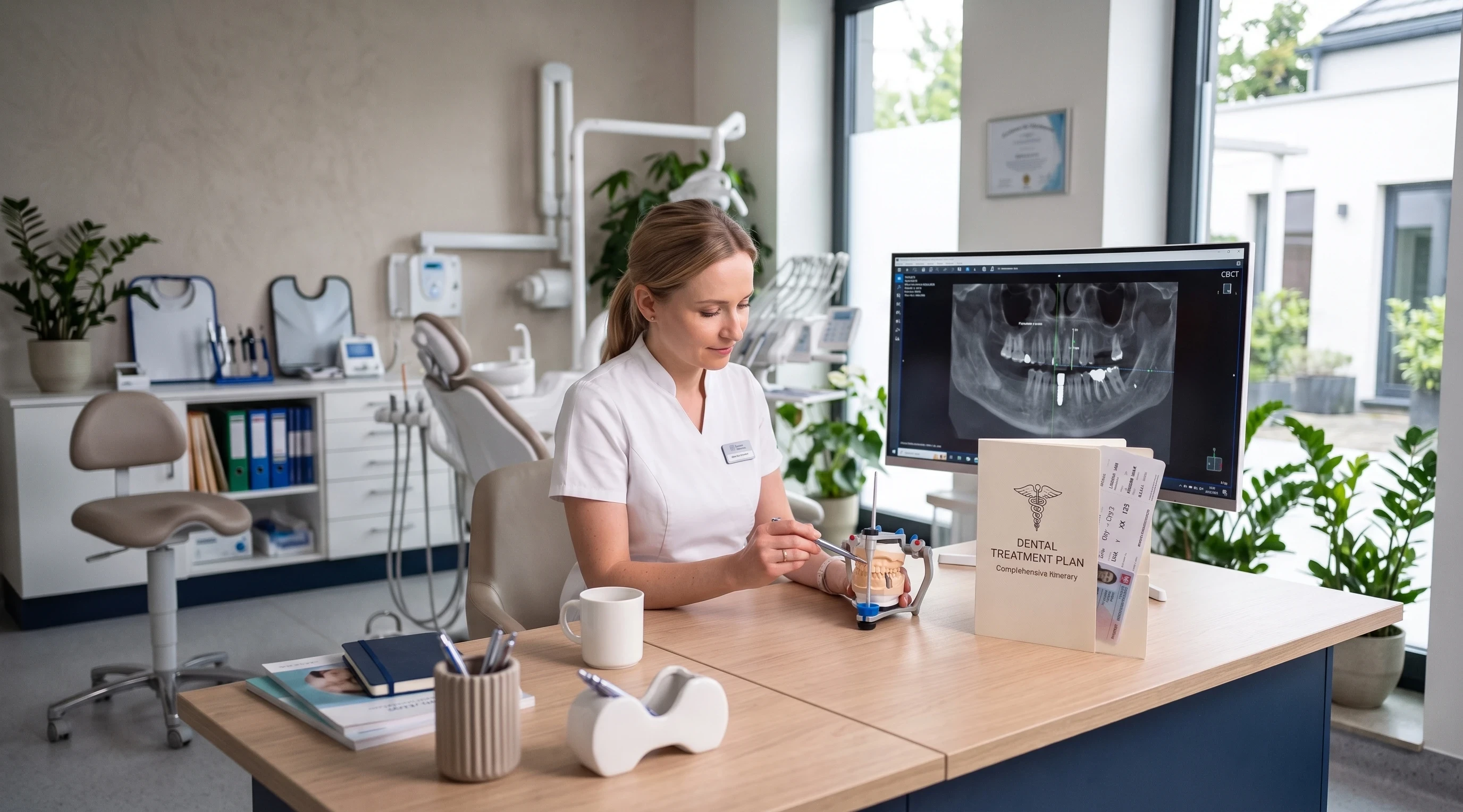
Why UK patients look at Poland
Dental implants are rarely funded by the NHS and are generally limited to specific clinical circumstances, such as after cancer treatment or significant facial trauma. The national standard of care for NHS-funded implant treatment reflects how restricted that route is. For most people, replacing a missing tooth with an implant means paying privately.
Poland is close, which matters more than it sounds. Flights from several UK airports to Warsaw, Kraków, Wrocław, Gdańsk and Poznań take roughly two to two and a half hours, so a return trip is a long weekend rather than an expedition. Polish private dentistry is well established, and a number of clinics have built genuine international practices with English-speaking coordinators and English-language price lists.
None of that is universal. Plenty of excellent Polish practices treat only local patients and have no English-speaking clinical staff. Ask each clinic directly who will speak to you in English: the coordinator who answers your email, or the dentist holding the drill.
What an implant quotation actually includes
An implant is three separate things, priced in at least three different ways.
The fixture is the titanium screw placed in the jawbone. The abutment connects it to the restoration above the gum. The crown is the visible tooth. Between them sit a healing abutment, impressions or digital scans, and laboratory work. When a clinic advertises an “implant price”, it may mean any combination of these.
Costs commonly quoted separately, or left out of headline prices entirely, include:
- Consultation and diagnostic imaging (X-ray or CBCT scan)
- Extraction of the failing tooth
- Bone grafting or sinus augmentation
- Healing abutment and final abutment
- Temporary crown worn during healing
- Sedation, and any prescribed medication
- Follow-up appointments and laboratory fees
Before comparing any two quotes, get both broken down line by line in writing. A quote that cannot be itemised is not really a quote.
Reliable numbers also depend on assessment. Cross-sectional imaging is recommended for assessing dental implant sites, with CBCT the usual method, because bone volume and the position of the sinus and nerve canal cannot be judged from a photograph emailed to a clinic. A price given before anyone has examined you is an estimate wearing a suit.
Comparing UK and Polish prices honestly
Published prices do not support a clean national comparison. Clinics structure their fees differently, “from” prices reflect the simplest case, and many list nothing at all. What follows is documented pricing from named clinics, accessed on 23 July 2026, with conversions at £1 = 5.07 PLN, based on the National Bank of Poland average rate of 5.0744 on 22 July 2026. Rates move: the pound bought roughly 4.90 zloty a year earlier.
A single tooth
| What the price covers | Clinic | Advertised price |
|---|---|---|
| Fixture and placement only | Implantis, Kraków (DIO or Anyridge system) | from 2,500 PLN (about £493) |
| Fixture and placement only | Implantis, Kraków (Straumann) | from 3,300 PLN (about £651) |
| Fixture and placement only | DentistinKrakow, Kraków | £350 |
| Fixture, healing ring, abutment and metal-ceramic crown | DentistinKrakow (Neobiotech system) | £670 |
| Fixture, healing ring, abutment and metal-ceramic crown | DentistinKrakow (Camlog system) | £1,031 |
| Fixture, titanium abutment, healing ring and porcelain-on-metal crown | Implantis, Kraków (DIO system) | from 5,880 PLN (about £1,160) |
| Implant, abutment and screw-retained porcelain crown | Bupa Dental Care, UK | from £2,400 |
Two things stand out. First, the same Kraków clinic sells a fixture for £350 and a finished tooth for £670 or £1,031 depending on the implant system. The cheapest advertised Polish figures can therefore be the first of those numbers being compared against the second one in the UK.
Second, once you line up complete packages, the difference is real but smaller than the marketing suggests: roughly £670 to £1,160 in these Polish examples against £2,400 as a UK starting point. Neither Polish figure includes the CBCT scan, which DentistinKrakow lists at £50 to £60 and Implantis at 270 to 360 PLN (about £53 to £71).
A full arch
Full-arch pricing is where comparisons go most badly wrong, because “All-on-4” is a marketing term applied to packages containing very different things. The most common error is comparing a Polish surgical stage against a completed UK treatment.
Dr Paweł Sawicki’s clinic near Warsaw prices the two stages separately, which makes the structure unusually visible:
| Stage | What it covers | Price per arch |
|---|---|---|
| Stage 1 | Extractions, four or six implants, screw-retained temporary bridge fitted the same day, post-operative reviews | from 28,000 PLN (about £5,520) |
| Stage 2 | Final composite bridge on a milled titanium bar | from 19,000 PLN (about £3,750) |
| Stage 2 (alternative) | Final zirconia bridge | from 25,000 PLN (about £4,930) |
| Both stages | Complete treatment, one arch | from 47,000 PLN (about £9,270) |
For comparison, Tooth Club in the UK advertises All-on-4 from £10,995 per arch, stating that the price covers consultation and assessment with X-rays and 3D scans, extractions where needed, four implants, temporary fixed teeth, the final bridge and post-treatment reviews. The clinic puts the general UK range at £10,000 to £20,000 per arch.
In these two advertised examples, the complete totals sit much closer together than fixture-stage comparisons suggest. Confirm the details before treating them as equivalents: the Polish figure specifies a composite bridge on a milled titanium bar, while the UK page describes what All-on-4 packages generally include rather than itemising a fixed contractual package, and does not make clear which final material the starting price assumes.
Compare Stage 1 in Poland against a complete UK package, though, and you appear to save around £5,000. That comparison is the one you will most often meet, and it is not a comparison at all.
These are “from” prices at individual clinics, not national averages. Treat them as worked examples of how to read a price list, not as the price you will be quoted.
What neither table contains
Add return flights for every trip, accommodation, airport transfers, food, time off work and the possibility of an unplanned extra visit. The NHS treatment abroad checklist asks patients to budget for fluctuating exchange rates, extended stays and return trips before deciding, and that is sound arithmetic rather than discouragement. On a single tooth, two return trips can absorb a meaningful share of the saving. On a full arch, whether they do depends on how many journeys your plan requires and how close the two quotations turn out to be.
Whether implants suit you at all
This is settled by clinical assessment, not by an article or an email. Still, it helps to know what a dentist is weighing up.
Gum health and any history of periodontal disease come first, alongside the volume and quality of available bone. Uncontrolled diabetes, bruxism and certain medications affecting bone metabolism also bear on how well an implant heals and holds, along with smoking and your ability to maintain good plaque control day to day.
Implants are not fit-and-forget. Peri-implant inflammation and bone loss can develop over time, particularly where plaque control and professional maintenance are poor; a 2025 systematic review and meta-analysis found peri-implantitis in roughly a quarter of patients with implants. They need careful cleaning at home and regular dental reviews throughout their working life, and that maintenance burden travels home with you.
None of these factors is automatically disqualifying. They shape a clinical judgement made after an examination, which is a different thing from a rule.
How the treatment actually runs
Implant treatment is staged around biology, and biology is the part no clinic can compress.
After placement, bone grows onto the implant surface in a process called osseointegration, typically over several months. Restoration timing is described in the literature using standard definitions: immediate loading within a week of placement, early loading between one week and two months, and conventional loading after more than two months of undisturbed healing.
“Teeth in a day” refers to the immediate end of that scale. In suitable cases a provisional tooth or bridge is fitted at surgery, and ITI consensus work supports this for carefully selected patients, subject to conditions such as adequate primary stability at placement. What it does not mean is that healing is finished or that the final restoration is in place. The teeth you fly home with on day one are usually temporary.
Grafting extends everything. Where a sinus lift is needed, Cambridge University Hospitals advises that graft material may take four to twelve months to be replaced by your own bone before an implant can be placed, though in some cases the graft and implant go in together.
Trips and time away
The figures below are planning scenarios to help you budget, not clinical requirements. Your treatment plan is the only document that tells you what your case needs.
| Scenario | Illustrative trips | Why |
|---|---|---|
| Single implant, adequate bone | 2 | Placement, then restoration after healing |
| Extraction followed by delayed placement | 2 to 3 | The socket often heals before the implant goes in |
| Implant with simultaneous grafting | 2 to 3 | Grafted bone integrates more slowly |
| Sinus lift as a separate stage | 3 or more | Graft consolidation can take many months |
| Full arch with immediate provisional bridge | 2 to 3 | Surgery and temporary teeth, then the final bridge months later |
What moves these numbers up or down: whether your diagnostics can be done in the UK and sent ahead; whether extraction and placement can be combined; whether grafting is staged or simultaneous; whether the clinic merges the impression and fitting appointments; how healing progresses; and the clinic’s own protocol.
Be alert to how trips are advertised. One Kraków clinic promotes a “three day” implant treatment: arrival and CBCT on day one, surgery on day two, review and flight home on day three. That is an accurate description of the first trip. The crown comes later, on a separate visit, months afterwards.
Length of stay is a different question from number of trips, and it splits three ways: being discharged from the clinic, being fit to fly, and having finished treatment. The first can be the same afternoon. The second depends on the procedure, sedation, swelling and bleeding risk, and travel health guidance is clear that your dentist should confirm you are well enough to fly. The third takes months. Ask the clinic, in writing, what review is planned locally before you leave, and what can safely be assessed remotely once you are home.
Checking the dentist and the clinic
A polished website and a fleet of airport transfers say nothing about surgical competence. Three checks are worth making, and all are free.
Is the dentist licensed? The Polish medical self-government maintains the Central Register of Physicians and Dentists, searchable by name or licence number at rejestr.nil.org.pl. It confirms the right to practise, licence status and any recorded specialisation. Worth knowing: this register is funded and run by the profession itself rather than by the state, and access is intended for patients checking their own clinician.
Is the clinic registered? Every entity providing healthcare in Poland must appear in the Register of Entities Performing Medicinal Activities, searchable at rpwdl2.ezdrowie.gov.pl. It covers both healthcare providers and individual dental practices, and confirms that the business is lawfully constituted and where it keeps medical records.
Where do complaints go? Poland’s Patient Rights Ombudsman handles breaches of patient rights, including for privately funded care. Concerns about a dentist’s professional conduct go to the Commissioner for Professional Liability at the relevant regional medical chamber, the body that opens disciplinary proceedings.
Now the limits. Registration proves legal and professional standing. It says nothing about how many sinus lifts your surgeon has performed or how their cases turn out.
Titles are worth understanding on both sides. Implant dentistry is not a separate recognised specialty on the GDC’s UK specialist lists, which cover eleven specialties. Poland’s recognised dental specialisations are likewise oral surgery, maxillofacial surgery, prosthodontics, periodontology, orthodontics and others, with implant work built through postgraduate courses and clinical experience rather than a specialty programme. So verify any formally registered specialty on the register, then ask separately about implant training, experience and case volume. The second question is the one that tells you something.
Questions to ask before you pay a deposit
- Who, by name, will perform each stage of my treatment?
- What is included in this quotation, item by item?
- What could increase the final cost, and by roughly how much?
- Which implant system and brand will you use?
- Are components for that system readily available from UK dentists?
- How many trips does my plan require, and how long should I stay each time?
- What happens if the implant fails to integrate, and who pays for what?
- Does any guarantee cover flights and accommodation, or only the clinical work?
- What aftercare will I need to arrange in the UK?
- Will I receive copies of my scans, treatment plan, implant references and records?
- Which parts of this plan are provisional until you examine me in person?
- What is your complaints procedure, and do you hold professional indemnity cover?
- How do we communicate if I have concerns after I get home?
If a clinic is evasive on the second, third or seventh of these, that is your answer.
Aftercare once you are home
Most implant treatment goes well. Planning for the exception is what separates a good decision from an expensive one. What to arrange before you fly, from records and stitches to a named UK dentist who has actually agreed to see you, is covered in dental implant aftercare abroad.
The BDA surveyed 1,000 UK dentists in 2022 and found that 86% had treated patients who developed problems after treatment abroad, with crowns and implants the treatments most likely to need follow-up work. On remedial cost, 65% put it at £500 or more, 51% above £1,000, and 20% above £5,000. Read that carefully: it reflects what dentists see in their chairs, across all destinations, not a failure rate for Polish implants. It is still a useful sense of what going wrong costs.
What NHS care in England will and will not cover. NHS England’s policy on self-funded treatment requiring NHS intervention is explicit. If you have paid privately, in the UK or abroad, and later develop a complication or acute problem, you are entitled to NHS assessment and evaluation to stabilise your condition. Pain and infection will be addressed. Beyond stabilisation, anything further is subject to normal NHS acceptance criteria, and the policy states that self-funded care the NHS would not routinely fund would not usually be offered or replaced once you are stable. It also expects patients to go back to the provider who did the work in the first place.
In practice: NHS services will assess and stabilise an acute problem. They will not rebuild your implant treatment. Arrangements differ across Scotland, Wales and Northern Ireland, so check the guidance that applies where you live.
What a private UK dentist may or may not do. This is a matter of willingness and capability rather than any legal duty. A dentist may be unfamiliar with the system used, may be unable to obtain compatible components, and may be reluctant to take responsibility for work carried out elsewhere without complete records. Dento-legal guidance for UK dentists notes that obtaining and interpreting overseas records can be slow and complicated by language, and that replacement parts may simply be unavailable in the UK.
The practical response is to arrange this before you fly, not after. Speak to a UK dentist about your plans, as the GDC recommends, and confirm they will handle maintenance. Bring home copies of your scans, radiographs, treatment plan, consent forms and the implant brand, size and component references. That last item is the difference between a repair and a puzzle.
Guarantees and what happens if something fails
Guarantee terms vary enormously between clinics, so the only ones that matter are the ones you have been given in writing. What is worth understanding is the shape they usually take.
Implantis in Kraków publishes its warranty terms in English, and they illustrate the pattern well. The implant screw carries five years, ten years or a lifetime depending on the manufacturer’s own guarantee. The crown on top falls under fixed prosthodontics at two years. Temporary restorations carry none. Work placed on implants fitted at another practice carries none. The warranty may be reduced or invalidated if oral hygiene is neglected, if the dentist’s instructions are not followed, if gum or bone recession occurs naturally, if a restoration is damaged accidentally, or if an illness such as diabetes affects the patient’s dental condition.
One condition deserves particular attention from anyone flying in: the warranty depends on attending a check-up and hygiene appointment at that clinic every six months. Read as written, honouring the guarantee means returning to Kraków twice a year.
Separate out what a guarantee actually delivers:
- Replacing a component such as a crown or abutment
- Replacing a failed implant
- Repeating the surgery, which means new appointments and new trips
- Refunding what you paid
- Covering your flights and hotel
- Compensating you for harm
Most clinic guarantees address the first three. Very few address the last three. A guarantee that promises free replacement surgery is a real benefit, and it can still leave you paying £400 in flights, four nights of accommodation and a week of annual leave to collect it. That is not sharp practice; it is the ordinary meaning of a clinical guarantee. Just price it in.
For a dispute you cannot resolve with the clinic, the routes are the regional medical chamber for professional conduct and the Patient Rights Ombudsman for patient rights. Contractual and compensation questions turn on the specific agreement you signed and on Polish law, and are worth independent legal advice rather than guesswork.
Insurance, GHIC and paying safely
GHIC and EHIC. These give access to state-provided healthcare that becomes medically necessary while you are visiting. They do not cover private treatment, and the NHSBSA is explicit that a card is not a substitute for travel insurance. Planned private implant treatment sits entirely outside them.
Travel insurance. Standard policies are built for the unexpected, and planned treatment is by definition expected. The NHS states directly that most travel insurance policies will not cover you for planned treatment abroad and that specialist cover may be needed. Check the wording for complications arising from elective treatment, and check it before you book.
The S2 route. This is genuinely NHS-funded treatment in the EU or Switzerland, and it is not a back door to cheap private implants. The conditions are prior authorisation before treatment starts, care delivered through the other country’s state healthcare system rather than privately, and treatment the NHS would routinely commission for someone in your circumstances. The route does not cover implant treatment independently booked as private care, and implants are rarely commissioned by the NHS in any case, so it almost never applies to the treatment described in this guide.
How you pay. Section 75 of the Consumer Credit Act can make a UK credit card issuer jointly liable with the seller for breach of contract or misrepresentation, where the cash price is more than £100 and no more than £30,000, and it can apply to purchases from overseas sellers. Paying even a deposit by UK credit card can bring the whole purchase within scope.
The protection is real, but it is not automatic, and there are ways to lose it. Paying in cash or by bank transfer at the clinic falls outside it. So does paying by debit card, which leaves only chargeback, a card scheme rule with a tight time limit rather than a statutory right. Standard Section 75 protection does not apply where the cash price exceeds £30,000, although other provisions, including Section 75A in some credit arrangements, may sometimes be relevant.
It also depends on an intact debtor-creditor-supplier relationship between you, the clinic and your card issuer. Paying through a booking agency, a medical tourism intermediary or a third-party payment processor rather than the clinic itself can break that chain, and the Ombudsman notes that whether the relationship exists is not always straightforward. Whether an individual claim succeeds is a matter for your card issuer and, on appeal, the Ombudsman.
Weighing it up
| Potential advantages | Potential drawbacks |
|---|---|
| Genuine savings on complete treatment, clearest on single teeth | Multiple return trips, each with cost and time off work |
| Short flights and EU membership | Guarantee conditions that assume you live nearby |
| Established clinics with international experience | UK aftercare must be arranged separately |
| Same implant systems and materials as UK practices | Complications may mean returning to Poland |
| Written, itemised plans from the better clinics | Exchange rate movement between quote and payment |
| Public registers you can search yourself | Redress is slower and harder across a border |
Red flags worth walking away from: a firm price quoted before anyone has examined you or seen a scan; a refusal to itemise; pressure to pay a large deposit today; a named implant system that cannot be confirmed in writing; vagueness about who performs the surgery; a guarantee that exists only in an email; and any suggestion that healing can be skipped because the temporary teeth look finished.
Frequently asked questions
Are implants genuinely cheaper in Poland? They can be. In the complete-package examples reviewed for this guide, Polish prices were lower, although the difference was smaller than headline figures suggested. Compare fixture-only prices against UK complete packages and the saving is an illusion.
How many trips will I need? Usually at least two, more if grafting is involved. Your treatment plan is the only reliable source.
Can it all be done in one visit? A temporary tooth can sometimes be fitted at surgery in suitable cases. Healing still takes months, and the final restoration comes later.
Are Polish dentists properly regulated? Yes. Dentists hold a licence to practise and clinics must be listed on the RPWDL register. Both are publicly searchable, and both confirm status rather than skill.
Will a UK dentist look after implants placed in Poland? Some may be willing to provide maintenance, while others may not, particularly if the implant system is unfamiliar or the records are incomplete. Arrange this before you travel.
What if an implant fails after I get home? In England, NHS services will assess and stabilise an acute problem, and arrangements elsewhere in the UK differ. Definitive repair depends on your clinic’s guarantee, which usually means returning to Poland, and on what a UK dentist is willing to take on.
Does GHIC cover this? No. It covers medically necessary state healthcare during a visit, not planned private treatment.
Can I fly straight after surgery? Follow your treating dentist’s individual advice. It depends on the procedure, any sedation and expected swelling.
What records should I bring home? Scans and radiographs, the written treatment plan, implant brand, size and component references, consent documents and guarantee terms.
Making the decision
Choosing where to have implant treatment should come after a clinical assessment, not before one. Get a complete written plan from every clinic you are considering, in the UK and in Poland, and compare them item by item rather than headline by headline.
Then run the real total: treatment, every flight, every night of accommodation, time away from work and a realistic allowance for one unplanned trip. Check the dentist and the clinic on the public registers. Read the guarantee as though you will need it. Arrange your UK aftercare before you book anything.
Some people will do that arithmetic and find Poland is clearly the better decision. Others will find that once the trips are counted, the saving no longer justifies managing complex treatment from 900 miles away. Both are sensible conclusions. What matters is that you reach yours from a full treatment plan rather than from a number on a landing page.
Sources
Official UK guidance
- NHS England, Avoidance of Doubt: Clinical Policy for Self-Funded Dental Treatment Requiring NHS Intervention
- NHS, Going Abroad for Medical Treatment
- NHS, Treatment Abroad Checklist
- NHS, The Planned Treatment (S2 Funding Route)
- NHS Business Services Authority, Get Healthcare Cover for Travelling Abroad: GHIC and EHIC
- General Dental Council, Going Abroad for Dental Treatment
- General Dental Council, Specialist Lists
- Financial Ombudsman Service, Goods and Services Bought on Credit
Official Polish registers and patient rights
- Central Register of Physicians and Dentists
- Polish Supreme Medical Chamber, information about the Central Register
- Register of Entities Performing Medicinal Activities
- Polish Patient Rights Ombudsman
Clinical evidence
- Morton et al., Group 2 ITI Consensus Report: Loading Protocol Definitions, Clinical Oral Implants Research, 2018
- Morton et al., Group 5 ITI Consensus Report: Implant Placement and Loading Protocols, Clinical Oral Implants Research, 2023
- Prevalence of Peri-Implant Mucositis and Peri-Implantitis Under the 2017 World Workshop Criteria: A Systematic Review and Meta-Analysis, 2025
- American Academy of Oral and Maxillofacial Radiology, Position Statement on Selection Criteria for Radiology in Dental Implantology
- Cambridge University Hospitals NHS Foundation Trust, Sinus Lift Procedures
- Royal College of Surgeons and Restorative Dentistry UK, Standard of Care for NHS-Funded Dental Implant Treatment
UK dental profession and overseas treatment
- British Dental Association, UK Dentists Picking Up the Pieces from Dental Tourism Boom, 2022
- British Dental Journal, Contemporary Dental Tourism: A Review of Reporting in the UK News Media, 2025
- Dental Defence Society, Managing Follow-Up Care for Patients Treated Abroad
Pricing examples
All prices were accessed on 23 July 2026 unless otherwise stated.
- Bupa Dental Care, UK implant pricing: single implant from £2,400, including the implant, abutment and screw-retained porcelain crown
- Tooth Club, UK All-on-4 pricing: from £10,995 per arch
- Implantis, Kraków: price list and warranty terms
- DentistinKrakow, dental implant prices in pounds sterling
- Dr Paweł Sawicki and Prodental, full-arch implant pricing, Legionowo near Warsaw
- National Bank of Poland, Table 140/A/NBP/2026: £1 = 5.0744 PLN on 22 July 2026
Who wrote this
I’m Chris Sroka. I write researched English content for dental clinics, medical tourism brands and the agencies that serve them: patient-education articles, treatment pages and content refreshes, sourced and fact-checked to the standard of this guide.